Grasshoppers
The Adventures of Maya the BeeThe Grasshoppers enter the narrative through one unusually talkative encounter with Maya, in which an unfamiliar insect makes hopping—not flight—the measure of distinction. The encounter gives the creature a vivid physical profile and a sharply individual voice: playful, interruption-prone, and confident that Maya has mistaken her own advantage in the air for universal superiority. Its observations about human beings extend that comic reversal, making the Grasshopper both an object of Maya’s curiosity and a commentator on the assumptions creatures make about one another.
Appearance and Encounter
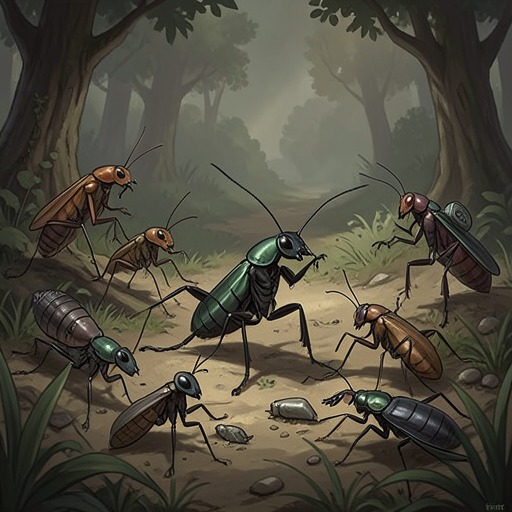
Maya meets one of the Grasshoppers in a patch of forest plants and flowers, after sipping nectar from clover. The insect is perched on a blade of grass bent above her flower. At first she is frightened by its lean, green shape, but fear gives way to intense curiosity, and she stays still to study it. Its unusually prominent forehead suggests horns at a glance; long, fine feelers grow from its brow, while its body and eyes are green. Delicate forelegs and thin wings contrast with its most conspicuous feature: great jointed hindlegs held up over its body.
The Grasshopper’s appearance is matched by a comic mixture of manners and mischief. It addresses Maya as mademoiselle and, annoyed by her astonishment, asks whether she has never seen a Grasshopper before or is laying eggs. Maya rejects the suggestion as absurd and explains that laying eggs would usurp the queen’s sacred duties. Their exchange establishes a difference in outlook as well as species: Maya understands herself through the responsibilities of the bee colony, while the Grasshopper approaches the meeting as an occasion for teasing conversation.
Hopping as Skill and Social Identity
The Grasshopper describes hopping as an impulse it cannot resist. Conversation is repeatedly interrupted when it suddenly feels compelled to leap away, wherever it happens to be. On one occasion it turns partly around before departing, its long hindlegs resembling clock hands at five minutes before half-past seven. It then asks whether Maya can hop too. The question is both an invitation and a test: the Grasshopper treats its characteristic movement not as a curiosity but as a capacity worth sharing and comparing.
Its invitation to a hopping-match makes that conviction explicit. The contest is to take place the following day in Reverend Sinpeck’s garden, and the Grasshopper offers Maya a complimentary ticket left over by its old woman, to be exchanged for a compliment. It expects to break the record. Maya dismisses hopping acrobatics as uninteresting beside the higher interests of a creature that flies. The Grasshopper answers that flight is common among creatures, whereas only very few can hop. Its argument turns Maya’s dismissal back on her: she has judged another creature’s pursuit by the standard of her own ability, without understanding what makes the other’s skill rare.
To demonstrate the scale of that skill, the Grasshopper cites members of its own family said to have hopped three hundred times their body length. It argues that even an elephant, despite being the largest animal in the world, cannot hop as high. The figure is part of the Grasshopper’s boastful case rather than an independently verified measurement, but its purpose in the conversation is clear: it asks Maya to reconsider what counts as impressive. The contest, and the possibility of a record, give hopping a social dimension as well as a physical one, turning an individual ability into something displayed, compared, and celebrated.
Observations on Human Beings
The Grasshopper’s conversational confidence extends to a deliberately skeptical account of human speech. It says that whether human beings possess a language has not been proved, since their sounds seem to produce some mutual understanding but are harsh and unlike the sounds of nature. Its judgment is not wholly dismissive: it credits them with trying to make their voices more pleasant. As an example, it recalls two boys blowing through a blade of grass to make a whistle, which it compares unfavorably with a cricket’s chirping while acknowledging the effort.
This account is comic because the Grasshopper treats human communication as an unresolved natural-history question, then assesses it according to its own standards of sound. The same reversal shapes its exchange with Maya: what seems self-evidently important to one creature may look unimpressive to another. The Grasshopper does not claim to know the future; it jokes that only the tree-toad can read it, and that the tree-toad never tells. Maya responds with admiration for how much the Grasshopper knows and asks whether it understands human language. Its answer makes observation, speculation, and humor difficult to separate, while keeping the conversation grounded in the limits of what any creature can confidently know.
Narrative Role and Disappearance
The Grasshopper’s appearance is brief and episodic. It reappears after Maya tries to fly away, resumes the conversation with another interruption, invites her to the contest, and challenges her assumptions about hopping. Its movement shapes the scene’s rhythm: each sudden departure seems to end the exchange, but the Grasshopper returns long enough to add another joke or argument. The pattern makes its restlessness part of its characterization rather than a detail of appearance alone.
After the discussion of human language, the Grasshopper hops away once more, and this time Maya waits for it in vain. She searches among the grass and flowers but cannot find it. The encounter therefore ends without a contest or a settled answer to their disagreement. What remains is a reversal in Maya’s perspective: flight has not proved a universal measure of superiority, and the Grasshopper’s defense of its own distinctive skill has shown her how limited that measure was. Through this lively but unresolved meeting, the Grasshoppers contribute an episode of comic cross-species observation to Maya’s wider encounters beyond the hive.